
Webinars
Equity in Action through Teaching, Data and Social Mobility | Sally Newton and Paul Tullock
How do you build a curriculum that supports every learner, embraces digital, and proves its impact?
In this episode of Voices in Education, host Abdul Chohan speaks with Sally Newton, CEO of Laidlaw Trust, and Paul Tullock, Director of PedTech and Innovation, about their backgrounds in education, the mission of Laidlaw Trust, and the importance of a tailored curriculum to support social mobility.
They discuss the role of digital transformation in education, the challenges of addressing SEND, and the significance of measuring impact and outcomes.
The conversation emphasises collaboration among schools and the community to create a meaningful educational experience for all students.
Meet the Speakers
Abdul Chohan
VP of Education Strategy
.png?width=200&height=200&name=Abdul%20headshot%20(100%20x%20100%20px).png)
Abdul Chohan is a recognised leader in educational technology transformation. With 20 years of experience as a teacher, school founder, and Multi Academy Trust CEO, Abdul has helped thousands of educators successfully implement digital strategies that deliver both operational efficiencies and improved outcomes for learners.
Sally Newton
CEO, Laidlaw Schools Trust
Sally Newton brings over two decades of experience in education, having led schools, shaped national policy, and driven rapid improvement across diverse settings. Her leadership is rooted in innovation, inclusion, and a deep commitment to unlocking potential in every child.
Paul Tullock
Director of PedTech & Innovation, Laidlaw Schools Trust
.png?width=550&height=550&name=Sally%20Headshot%20(1).png)
Paul Tullock brings extensive experience in digital learning, having led whole‑school and multi‑school technology strategies, supported national and international organisations and delivered professional learning for educators across the UK. He holds a range of industry accreditations and has been recognised for his innovative use of technology to enhance teaching and learning.
Abdul: Hello everyone. Welcome back for another episode of Voices in Education by Showbie. My name is Abdul Chohan, I'm the Vice President of Learning at Showbie, and today we have two guests from the Laidlaw Trust. We have Sally Newton, who's the CEO — welcome, Sally — and we have Paul Tullock, who is a Director of PedTech and Innovation. Welcome, guys.
Sally / Paul: Thank you. Thanks Abdul.
Abdul: Great to have you here. Kind of wanted to just start off with you as people — where did you start off? How did you get into education? There's always stories behind people. So let's start off, Sally — tell us a little bit about yourself. How did you end up here?
Sally: Oh, well, yeah, I was always destined to be in education. So I went straight from education back into education. My dad was a teacher. Dad was my favourite person in the world. You know, you hear people talk about how inspirational their parents were — I can't say enough how much of a, you know.
Abdul: Primary or secondary?
Sally: So he was special — special school secondary. And I spent a lot of time, you know, back in the day when you were allowed to go on school trips with your parents — I mean, what was that about? But yeah, I went with his school to France, different residentials. I was always in there doing volunteering work, I just loved watching young people learn. I knew from really, really early on that I wanted to be a teacher, and then went straight from university into teaching on that sort of DfE fast track programme, as it was then. So quite quickly into leadership, and then just really caught the bug. And then I was really lucky because in one of my headships I had a chair of governors who was from a business background, and she mentored me in the most exceptional way and really brought those two worlds of business and education together for me. Hence just doing what I absolutely love to do — it's a privilege.
Abdul: Well, and always in the northeast?
Sally: Always in the Northeast. Yeah.
Abdul: Really good understanding of that.
Paul: Yeah, I can't follow that, man — that was impressive. I came from a very working class background, first person to go to university in our family. Had no idea what I wanted to do when I left. I kind of did finance because I was always very good at maths and things like that. And then I went on an outdoor residential holiday as a volunteer with some underprivileged kids from Edinburgh, and I was told that I needed to be working with children. So I basically ended up applying on a skit course to become a primary school teacher. My sort of goal was to make sure that no child had the same experience that I had, because I didn't enjoy school.
So I started working with year 1, with the really small ones, and then I got really interested in how we could use technology to support all learners, because I had a very unique child who was wonderful — I'll always remember him to this day — but he was written off by a lot of staff, and it took me about four weeks into teaching to realise he just couldn't access what he was doing. So I needed to help him, and I went out of my way to find things that would help him. And then I became absolutely fascinated — I ended up teaching every year group in primary school. Then I became an Apple Distinguished Educator in 2017 because I was so immersed in how iPads could change learning. Then I became an Apple Professional Learning Specialist. Then I left education in 2020, during Covid, to go and support other schools and trusts. But I really missed the day-to-day, making that difference, the projects, how we could impact in schools. And then the opportunity came to work with the Laidlaw Schools Trust, and I knew from reading the advert that the values of the trust matched my own values of what I thought education should be. From there it's been a really exciting journey for the past two years.
Abdul: Amazing. I've got a real soft spot for the North East because I went to university in Sunderland, so —
Paul: Greatest team on earth.
Abdul: Yeah — not even the greatest team in the North East, but you know. I'm not going to say anything, but for sure, definitely a soft spot for the North East. I do remember, at university, a friend of mine became a teacher there as well — I remember him coming back telling us stories about the classroom and education and so on. One thing's for sure, educators are always passionate about what they do, right — passionate about children, passionate about impact, wanted to make a difference and so on.
So, Sally, coming back to you — Laidlaw Trust's got a powerful mission. Tell us a little bit about the curriculum, how it's designed to support that social mobility, particularly in the communities you serve. I think a lot of the audience for Showbie and for the podcast aren't just in the UK, they're international as well, so understanding that local context is quite important, and I think sometimes the North East isn't a place everybody travels to all the time — so, an understanding of that. It would be really great to understand from you the vision, and what that local context looks like.
Sally: Yeah, and I think it's important as well, for people beyond the North East and within the North East, both nationally and internationally, to recognise that when we talk about the North East, we can't make generalistic assumptions about the whole of the North East — it's very nuanced in terms of its differences. And we really see that as a trust. We have 11 academies, we serve children from two years old up to 19, and we have three clusters — children from the Durham area, children from the Sunderland area, children from the Newcastle area. They're quite close in proximity, and when we talk about curriculum design, it might be really simplistic to think as a trust that we could put in a one-size-fits-all. We can't do that. We've got schools in Newcastle where there are 53 different languages spoken — the most vibrant multicultural communities, joyful, aren't they, Paul, just so amazing — but coupled with that, three quarters of those children in Newcastle are in deep poverty, entitled to free school meals. And then we've got our children from Sunderland, where we've got 99.9% white British — we have to work really, really hard there to create that diversity, to make sure they're not open to real threats from far-right behaviours, because they're just not immersed in a multicultural society there. And then in Durham, different again — slightly more affluent, slightly more advantaged, you might say, but really high levels of special educational needs and different needs as well.
So when we think about it, it would be very easy for me as CEO — and I know CEOs who do this, and do it really successfully — to create a curriculum where every classroom is the same and it's just on a different corridor. I can't do that, I simply can't do that. Might be easier if I could sometimes, but we need to meet the needs of our communities. But then we need to do it under a really values-driven methodology where we all believe the same — that's really deep-rooted, and that's where the mission comes in, around transforming lives through extraordinary education. It needs to be extraordinary, it needs to be something different, something that isn't just loosely based on compliance and exam results.
So we start with a curriculum framework around securing academic excellence — academic qualifications are the route to opening doors, but we know for our children that's not the only thing they're going to need. The second element is building tomorrow's healthy, confident, productive citizens — if not us, then who's going to do that for our young people? And the third element to our curriculum, in its broadest sense, is about delivering transformational change — looking at multi-generational unemployment, how will we be the catalyst to shape that change moving forward. So we've had to be brave in our curriculum choices and our curriculum model. We've had to make sure every child leaves us with strong foundational skills and knowledge across subjects, but also that every child will have a digital qualification — call that gaming if you want to call it gaming, but what we call it is delivering on a mission to make sure children have the skills they need to progress into multifunctional destinations, and critically that our children leave us with a sense of agency, independence, and commitment to wanting to do something for the wider world.
So, as you'd expect in our context, our curriculum includes really structured reading programmes right from early years through to post-16. We've got high levels of mobility and low levels of literacy on entry, often, that need to be tackled before we can get to any curriculum.
Abdul: Is that across the community, in terms of literacy?
Sally: Yeah, yeah. We're seeing, certainly with a lot of our younger children, the school readiness survey just came out last week again — and why were we shocked that children still aren't ready to start school? One of our biggest drivers, and we'll come on to talk about the role of the Laidlaw Foundation, is that we're offering an equitable 30-hour access to early years education for our children, to really secure those fundamentals in reading. Coupled with that is a strong sense of oracy, rhetoric — we know that no matter what qualifications our children get, they need that confidence and independence to walk into any room and hold their own. And critically, creating the range of co-curricular and enrichment opportunities that are usually seen in independent schools — we need to do that. We're under no illusions that our children aren't necessarily afforded the opportunities that, for example, my children are, or Paul's children are, in terms of the range of things they access. So again, if not us, then who?
So critically, in our curriculum as well, we parallel high academic success with daily character skills lessons. I often use the analogy that we wouldn't just expect a year four pupil to learn how to do long division by osmosis — we'd model it, scaffold it, let them try it independently, have a video on Showbie so they could address misconceptions, revisit learning, build on secure learning blocks. But things like resilience, teamwork, adaptation — I'm not sure how we're just expecting children to pick this up if we don't teach it explicitly. So we do, at Laidlaw Schools Trust. And those essential character skills — I get really irritated when people describe them as soft skills, they couldn't be more powerful skills, so they're certainly not soft. We give them as much ownership, as much emphasis in our curriculum as we do the academic side, by doing it daily.
And then diversity and representation are all baked into our curriculum choices. I'm really clear that our children need to see themselves in what they read and what they learn, and they also need to be equipped to navigate that wider world with real empathy, but real ambition as well. And finally, we're unapologetically focused on destinations. We start with the destinations — we look at the local economy, the North East Combined Authority's Growth Plan over the next 10, 20 years, the rising tech industries, we know where successful destinations are regionally and nationally, and then we map our curriculum accordingly and track back from those destinations, to make sure all of our learners have a visible pathway — whether that's into higher education, apprenticeships, or employment — so that everybody has a real sense of destination and achievement.
One of the reasons we need to do that — I've said it before, Abdul, I may well have said it to you, but I'll say it again — it's about a shrug. When I was in one of our secondary academies, chatting to a year nine boy who's absolutely great, I said to him, "what's your thoughts, what are you going to do when you leave?" He just looked at me and shrugged. And that shrug will always stay with me. It doesn't speak about what he's like as an individual — he's bright, he's funny, he's capable — but what it speaks to is that the curriculum wasn't, at that time, feeling relevant or any part of his future. That moment said everything, and it said to us that we needed to do things differently. Start with the destination, track back, make it relevant, make it purposeful, and we'll see less of that.
Abdul: I love the fact that it's that destination basis — such a powerful thing. Wherever you go in the world right now, you ask a student who's about to leave school what they want to do when they leave, and they have absolutely no idea. It's never been discussed, they've never really even thought about it, they don't know any information about what's out there. The focus has purely been on passing the exam. And I must say, I am a little bit disappointed with the curriculum reform, if I can say that, because I don't think it's about tinkering around the edges of the national curriculum, or renaming the EBacc as something else — I think it's really got to be about fundamentally rethinking what we teach, how we teach it, and crucially, why it matters to these young people — what relevance is there in teaching this subject.
Sally: Yeah, I think curriculum will always be the most powerful tool for social mobility. It's just how brave trusts, academies, and schools are willing to be, with a sort of accountability framework such as ours at the moment, which I won't get into.
Abdul: And the government, I suppose, as well, in terms of bravery on their part.
Okay, over to Paul — I'm going to ask you this, but feel free to chip in, Sally, because you've covered a few things I was going to ask. You guys have recently adopted Showbie, and there are a lot of learning platforms and different types of technology out there — how do you support that changing journey and show that no one's left behind? There was a Minister of Education I was speaking to the week before BETT, just two weeks ago, and one of the things she was talking about was that everybody's at different stages — you've got teachers with a degree of digital maturity, others don't, some are really scared of it, some can't wait to get onto the next thing. And the reality is there are so many different tools out there that do similar things. So what do we focus on in terms of creating that digital maturity of staff, building consistency, and supporting that journey of change?
Paul: I think it's really important that when we started, it wasn't about a flashy rollout, and it wasn't about using the first tool, the best tool, or the in-trend tool, so to speak. It's all about impact, and we need to get that right — it's all about the pedagogy first. So for the first couple of months, we didn't actually do anything, did we — we just met our schools. We went and visited, talked to staff, talked to students, talked about their successes, their challenges, what they needed to do, what the students wanted to do, what we thought might support the students. It's really important that it comes from pedagogy first, which is why we changed our tack from EdTech to PedTech straight away — it's not what we do, it's not what we're choosing, it's not how we do it, it's why we're doing it.
All of our schools are at different stages — some have had iPad before, they've been using Showbie before, they're at various levels; some have got totally different needs, totally different, very diverse cohorts, totally different stages. It's important that we meet the schools where they are. We've really stripped that back, because in Showbie there are lots of fantastic tools, but we need to make that consistent. And it comes back to a phrase that always stays with me — I think it's yours — let's see if I can get this right: good schools —
Sally: Good schools are consistent. Outstanding schools are consistently good.
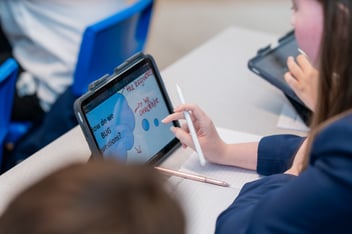
Paul: And I think that's what we need to do. We need to make sure every student's getting the same level, whether they're in English, maths, science, whether they're in primary or secondary — getting the level that meets their needs. And that's where we're quite lucky, in that we've put in a foundation — we've really looked at what our lessons look like, what we want our teaching model and our learning to look like, and stripped that back. We've really thought about how that looks inside Showbie and what the best tools are for us to use, so we have a very consistent approach with expectations about what we expect to be inside Showbie. Layered with that are the tools we can use to adapt the teaching as we go, the assessment features that help us take data on the spot, so we can adapt within lessons rather than waiting until after, until we've looked at books and those kinds of things.
So we've stripped it back, and some schools are ready to move a little quicker, some have bought into it, some have adapted how they teach and found their own ways to go. But there are some really powerful tools in there, and we're finding impact there — and we're very lucky in that we have a team of lead digital learners, which I call the PedTech team (always just drop the PedTech team in), but they support every school. So the schools know that if we build it from the inside, we understand the schools, rather than bringing in external people to help with that training — the schools know they have somebody who understands the school.
Abdul: Sorry, I'm just interrupting there — that is such a key aspect of a successful digital strategy, because you can't just keep spending money on external support all the time. There are times when you might need that, but the importance of building your own internal team is really, it's gold.
Paul: Yeah, and we're very lucky, we've got a range of experience across that team — secondary, primary, those with experience of leading, those who are very creative — and we can bring all of that together. I guess it comes back to my own experience of working as an APLS — it was great, I could go into schools and work with them, but they didn't have to do what I said, there was no accountability whatsoever. Whereas with our own team, the team understands the schools, and they're supporting a range of staff and know what that looks like day to day in the various contexts. We can make our staff a little more accountable, and make sure they understand why we're doing this, and we're living and breathing our own vision. I think that makes all the difference, having that internal team — and the impact so far has been great.
We've had staff who really didn't want to go with Showbie or iPad or anything — they were very happy with where they were at. And we have one member of staff who stands out — she said, "I'm in my fifties, this is new, there's no way I can do this." After six weeks of support, she said, "don't take this away from me — this is easier than I've had it before. I can pinpoint what's going on in my class at any moment, I can get feedback, I can assess, I can adapt the learning, I can change things, and everybody has the same access and it's equitable for everybody." And she said, "but also, I'm not stuck at the front of a classroom, I'm no longer the person who imports the knowledge — I facilitate what's going on in this classroom." And I think that's really powerful.
Abdul: And you're part of the PedTech group as well, aren't you? Tell us a little bit about that, because I know there are lots of different schools with different contexts and technologies that are part of that group — I think the audience would love to hear a little bit.
Paul: Yes, so we joined the National PedTech Partnership, which is led by Dr Fiona Aubrey-Smith. The reason I was so intrigued by it is that I think it's really important that we're always learning as well — we learn from each other, we ask questions, we always look to improve. We might be very knowledgeable, we might have a lot of experience, but sometimes you need that trusted network, and somebody to ask the questions and challenge you as well. We wanted to join this amazing, quite large network, and have input which would be fed back and might change the way education looks across the landscape in the UK — we felt that if we were part of this team, we wouldn't just be on the journey, we'd be helping to shape it. The wealth of experience when you meet up with people, and the impact it has, how it reinvigorates you and excites you and helps you think about your own context, is fantastic. We joined that June last year, and it's been a real game changer — it's helped me personally look at things in so many different ways.
Obviously there are lots of buzzwords out there, AI is taking over, all those kinds of things — but when you get together in that partnership with like-minded people who are all there for the same goal, to improve the lives of their kids, their families, their cohort, their communities, it really helps you hone in on what's important. And through AI, it's been really interesting to listen to every school's own experiences of it and how they've adapted. Actually, I'd say the biggest takeaway for me from that partnership so far has been the human element — technology doesn't replace anything, it's not a silver bullet. It can enhance and really be the enabler, but actually the human element is still the person in that room, and the relationships. I think that's helped me frame things in a totally different way, but it's been such a valuable network.
Abdul: That's really quite powerful. I think that human element is a big thing, and the more I think about it, the more organisations and schools I work with, it comes into play again and again — a teacher at the front of the room can tell the mood of a class, the way they've walked in, how they've sat down, whether it's been raining outside, the behaviour of the children — they can pick it up, they can adjust things in the class. That human connection is just so powerful. And I think if technology is used as a means of communicating that human value, then that use of technology can be just as powerful. So, like verbal feedback in class — if I can do that with voice notes, I can do it in class verbally, but if I want to give verbal feedback to a student who's not in class and the tech allows me to do that, then, why not?
Paul: Yeah, so I think the humanistic element is so powerful.
Sally: And I think, just picking up on that, to go back to this journey and different schools being at different stages with Showbie — which Paul probably wouldn't bring up himself — I think one of the most critical elements is that we had two early-adopter schools who were one-to-one before Paul's appointment. I was quite proud of them, Abdul.
Paul had to really come in and use that human element to say to me, "Sally, this is substitution you're looking at — this is not successful integration of Showbie, this is not changing pedagogy." And that was a lightbulb moment for me. Actually, those two schools have been harder to move in terms of their practice, because once you already inhabit — you already think something's working well, you're not seeing the art of the possible.
Paul: Is it seeing the art of the possible? What it actually is, is just that substitution — if you will, Abdul, changing blackboards to whiteboards, changing a textbook to an iPad, not fundamentally changing the way that we teach. So I don't know about you, but I actually think they've been more difficult to move on the journey than the rollout of new schools.
Sally: Yeah, I'd agree with that. But I think we had a clear vision and a clear strategy from the start, so they could understand why they need to change. And they are changing — I think the rate of change maybe appears slower because they've been embedded that little bit longer.
Paul: But I think it's also — it's not only, a phrase my wife uses all the time — "if you do what you've always done, you get what you've always got." And I think it's seeing what else we could do that might enhance things this year. That's really helped drive the development of the curriculum in those schools as well.
Abdul: I mean, to build consistency it takes time — often what happens is technology comes in, everybody wants to do everything, and then you lose the consistency, but you get pockets of good practice happening here and there. And I think what I love about that pedagogical approach is that we're introducing it on a pedagogical basis — so if it's direct instruction, it's not about the device, it's not about Showbie or any other platform or app, what we're actually looking at is direct instruction, and this is the research that makes a difference — but these are the tools we're going to use to deliver that consistently across the trust. Getting that embedded — it's worth spending the time and taking it slowly to make that happen.
Paul: Yeah, and I think you need to be very careful about what you choose first, and it needs to speak to your teams. We were knocking at an open door, because we just needed to ask our teams, "what is your biggest challenge?" Imagine being a teacher standing up in front of 30 children, 12 of whom have got lots of gaps due to persistent absence, six of whom have English as an additional language, another four international new arrivals — you ask the team what their biggest challenge is, and, well, there we go, we're not exactly pushing at an open door. Accessibility — that's the first thing we're going to do with technology. And straight away, our fantastic teams are on board, because they can see it works. And you look back now and think, how did they used to teach at the front of the classroom, clicking through 35 PowerPoint slides, to 30 children who have such acutely different needs.
Abdul: And you must have seen — taking accessibility, I'm going to come on to SEND in a minute — you must have seen a significant impact and change from an accessibility perspective for students, and equitable access.
Sally: Huge, huge. We're sick of talking now, aren't we, about behaviour versus conduct — so many people still talk about behaviour in a conduct sense. But when we talk about behaviour, we used to look into classrooms and think, how many of these children are inwardly truanting — not causing anybody any problems, but not there, not present, not engaged. They're just getting through the hours. But now it's a feeling, Abdul — sometimes you can't quantify it, but it's that buzz, that engagement — I think, to Paul's point earlier, not that teacher standing at the front of the classroom having to be the director all the time. We walk into classrooms and can't find the teacher, and that's where you truly know that every child can be engaged, and every child is now able to access learning. You feel it.
Abdul: Let's talk a little bit about SEND, because I've been speaking about this to lots of CEOs — speaking to Leora Cruddas, CEO of the CST, as well, getting her opinions. I went to the CST conference, the national one that happened last year — I think you were there as well, right? — and it was interesting to listen to the government, but if I was to sum it up, and I could be wrong, feel free to call me out — it's like, "this is a problem, but we haven't got the money to fix it, but we're going to keep going" kind of thing. And I think trusts are typically getting to a point where they're trying to figure out their own way of dealing with this, because we can't wait for a national injection of finance — that's probably not going to happen. So what does that look like, and how are you dealing with that as a crisis — if you want to call it a national crisis — how is Laidlaw Trust dealing with that, and does digital have a role to play in it?
Sally: Yeah, interestingly, we had our first inspection under the new toolkit in December, and the HMI said, in the feedback around SEND and inclusion, "this is a trust to lead, not plead" — because we anticipated this crisis. When I first joined the trust, I proposed a SEND and inclusion strategy, with three dimensions. One was around accessibility, universal offer, including a digital strategy. The second was around groundbreaking facilities — far too many of our young people who are in crisis are trying to be regulated in corridors, even in cupboards, in the most undignified spaces, when they need expert regulation, expert intervention, to be integrated and access learning again. And the third element was that we've internalised our own inclusion team, just as we've done with the PedTech team. I know we're very fortunate in terms of the backing of the Laidlaw Foundation, who provide sponsorship for us, and we've been able to do that with their financial backing and support — having our own educational psychologists, our own lead practitioners for social and emotional mental health needs, ASD. It really generates the sense that it's not somebody else's business, it's our business, it's our core business, and it's not just a bolt-on. So our SEND strategy really supports all of that, and the digital element of it, as you mentioned earlier, is all around accessibility, all around personalisation — if we get it right for children with additional needs, we get it right for everyone, and that's the way we view it.
Paul: Yeah, I totally agree. I think it's really important that digital is not seen as a bolt-on, it should underpin everything we do. In our vision we've got three strands — one is to improve the communication and workflow of staff and students, and through digital that really helps to enhance communication. The most important one is personalised, accessible learning — it's a major passion of mine, making sure every child has their needs met, and, more importantly, that they have a voice in the classroom. So we work really closely with the SEND and inclusion team, and the PedTech team work really closely to make sure all the tools available to support those needs are widely known across the trust. So lately what we've been doing is working with the SEND team, looking through our SEND registers, working with students, highlighting what tools might support those students, and then working with those students one-on-one, showing them where that might fit, rather than just saying, "by the way, there's a tool." We talked to them, we engaged with them — it's all about building confidence too, because they don't want to rely on having things done for them, they don't want to put their hand up and say they can't do this. But if we give them the tools —
Sally: Yeah, it increases that independence, increases that confidence, makes them part of learning, and helps them become a lifelong learner. That goes back to the character skills that we have.
Abdul: Yeah, and how important they are.
Paul: And I just feel accessibility is at the core of everything we do. There's a phrase I heard at ADI in 2017 that stuck with me, and it really drove that second core of our vision: it's "necessary for some, but great for all." So if we can model these tools — you might need to use them, but I'm going to use them as well, because it's a good thing for me to use. So we're approaching our staff and encouraging them to use those tools as they teach — show how you can dictate with your voice, dictate a sentence, use Siri to have something appear or check something, use spoken content, those types of tools. We're really encouraging that, because it's not only students, we have really diverse staff as well.
Abdul: Paul as well — very true. What data points are you using at Laidlaw to verify that the impact is happening — whether that's the Showbie Impact Report, staff feedback, qualitative, quantitative. How do you know the journey and direction of travel is having impact?
Sally: Two years ago now, when I took over as CEO, the trustees were instrumental — they're such a great group of people, so encouraging around being brave, doing things differently, doing what's ethically right. And, you know, we'll always have the pressure of exam results — we know how to track those, we're very good at that. So alongside all the standard stuff — attendance, behaviour, suspensions, exam results — we developed a balanced scorecard, because I firmly believe in "we measure what matters." Our balanced scorecard now incorporates character skills — we use the Skills Builder Framework to track quantitatively the progress of character skills across the eight domains, so we can pinpoint where there are weaknesses, and intervene, just like we would in maths.
We also track digital skills, using a digital literacy framework that Paul has developed, so we know where children are in their stages of development around digital fluency. We track health and wellbeing using the Good Childhood Index and compare that to national data, so we know where children are in terms of their feelings about themselves, their value in themselves, their contributions to society. We also track co-curricular participation, which we can correlate to attendance, sense of belonging, and character skill development, which I think is really important. And we've just started a partnership with Oxford University, who are going to support us in creating a longitudinal study around co-curricular activity and character, so we can see, when we're using external partners, what the impact and return is, in the broader sense, in terms of student outcomes from further enrichment brought into the academy. So that's really exciting.
Abdul: Wow, really powerful. You mentioned earlier about oracy and language development — it's one of the most powerful things that gives an employer a first impression of a person; a lot of decisions are made through that first impression of how a student, or a child, or an employee speaks and comes across, potentially opening doors to lots of other things. I think the character education piece is hugely powerful. Are you working with employers to look at that as well?
Sally: Yes. So we're also working with Voice 21 around our oracy programme. The way we've approached our relationships with employers is new and evolving — we've just launched a pilot programme which we're going to roll out across all of our clusters in Sunderland, in Pennywell. Bridget Phillipson came to launch the Fellowship of Education back in September. The Fellowship of Education is really designed — it's not a trust thing, it's a place-based thing — so we're working with schools across the Pennywell area in Sunderland who aren't part of our trust, but I'm not in the game of competing trust to trust, I'm in the game of collaboration. We've got different neighbouring schools, but we've got cousins, brothers and sisters who attend each of the schools — so it's about time we work together.
With employers, I get a little frustrated hearing about workforces not being ready, about young people not being sufficiently qualified in terms of their character. The Fellowship is designed to bring together employers, civic partners, community groups, under the umbrella that a child's education is everybody's responsibility — so don't tell us what's wrong, let's be part of the solution. It's a really innovative, brave idea, and it's a way for employers and partners to contact the schools, and schools to contact them, under a common platform, doing something really meaningful, not a one-off. So rather than just coming in to talk in an assembly — that's great, but can you also provide mentoring, work placements, is there a real long-term commitment to this partnership that you can provide. So the Fellowship of Education is doing that in Sunderland at the moment, and we're trying to codify a blueprint that could be adopted by other local authorities — we're certainly going to roll it out into Newcastle and Durham moving forwards.
Abdul: And for my last question — and then if you want to add anything, you can — Sally, from a multi-academy trust map perspective, are the MAT leaders getting curious about digital, about your approach? Is that something you're seeing increase across England?
Sally: Undoubtedly. I think people are no longer asking why, they're asking how.
Abdul: Yeah, yeah. I think it's moved into the realms of the how — people are convinced by the message, they're just not necessarily sure on the execution. And that's why you need a Paul Tullock.
Paul: Because you need to have a very clear direction and vision for what you're actually trying to achieve through digital. Putting devices in the hands of kids will just create substitution unless we're really clear about what we want to achieve in terms of the shift in pedagogy, reducing workload for staff, and accessibility, which is absolutely core for us. So I'd always say to people: strategy first, then implementation.
Abdul: And just to add to that — obviously it was BETT last week, and we had many conversations, but just wandering around and talking to people, it was exactly the same — how are you doing, what do you do. And we've just been talking to lots of different places, and saying, it's not how we're doing it, it's why are we doing it, what's your focus — and if we bring it all back to that, it becomes clear how we can make those changes to actually have lasting impact.
Sally: So a lot of trust leaders — we had conversations last week — are just keen to, there's a marked rise in interest in how to implement this. We're keen to not only showcase what we're doing, but invite people in to have those conversations. We won't always get it right, we won't always get it right first time, we're on a journey as well. We're not the finished article, and will never be the finished article — we'll always keep evolving, always keep changing, especially the more we work with employers, that's only going to develop over time. But by having conversations with other trusts and other leaders, we can make some real change, and hopefully that drives it at a national level, and it might become the norm — and then it's not extraordinary, what we're doing, but it does have extraordinary impact.
Abdul: A bit like Scotland, where you've got whole councils and swathes of the country that have gone down that route. I always used to give this example — probably about 10 years ago, it was all about the taps: people would just give out devices, the shiny stuff, and then turn it on and expect water to come out — but no one's thought about the plumbing.
Paul: Yeah, it's becoming increasingly obvious now that people are beginning to talk about the plumbing before they talk about the taps. And I think that whole strategic approach — all the things you've spoken about today, Sally, and the implementation part — it's all of that together that really delivers the water, basically.
Sally: That is the exact question — somebody came up to me and said, "we've got this amount of money, if we were going to put devices in, what would you recommend?" And I said, it's not about what device you use, you need to go all the way back — what's your goal, what are you trying to do, what problem are you trying to solve. And then, exactly the same — if you get the plumbing right, it doesn't matter what comes out.
Abdul: Absolutely. Look, guys, thank you very much for coming in today, and for sharing your thoughts — I'm sure it will be hugely valuable for people watching the podcast, taking that knowledge and wealth of experience from you. So thank you again for coming in and sharing your thoughts with us.
Sally / Paul: Thank you for having us. Great to see you, as ever. Thank you.

.png?width=352&name=Copy%20of%20Events%20(9).png)